Description of the GPAD API, the Application Programming Interface. Version 0.07 Updated on Date: 20221104
This is the description of the API from the point of view of the firmware within the General Purpose Alarm Device, aka the GPAD.
As of Version 0.07, the interface is through the USB serial and SPI, both. The serial BAUD rate is fixed at 115200 Serial messages are terminated with a single Line Feed, here after LF character (aka '/n' or New Line, which is ASCII 0x0A or DEC 10). The GPAD recognizes a limited set of commands. Some commands are one character only. Some commands are two characters followed by the LF. Some commands take messages by concatenating a message of up to 80 additional ASCII characters.
The SPI interface was added in version 0.07, and example code for it is available in the GPAD_API_SPI_CONTROLLER directory. Please see the README there for more information.
This SPI-implemented is implemented with two entrypoints, the single funcation alarm, and the function alarm_vent which takes and event structure. These may contain a null-terminated message string of up to
80 characters.
enum AlarmLevel { silent, informational, problem, warning, critical, panic };
// const char *AlarmNames[] = { "OK   ","INFO.","PROB.","WARN ","CRIT.","PANIC" };
const int NUM_LEVELS = 6;

const int MAX_MSG_LEN = 80;
const int MAX_BUFFER_SIZE = MAX_MSG_LEN + 1;
typedef struct {
                uint8_t lvl;
                // we will use a null-terminated string!
                char msg[MAX_MSG_LEN+1];
               } AlarmEvent;

int alarm_event(AlarmEvent& event,Stream &serialport);
int alarm(AlarmLevel level,char *str,Stream &serialport);
It is our intention to create additional entry points in what we call the "robotic_api" which will eventually explose all of the GPAD hardware to control by SPI.
The LCD is organized as four rows of twenty characters. The first row displays the alarm level by number and name { "OK ","INFO.","PROB.","WARN ","CRIT.","PANIC" } The remaining rows display the message sent by the controller with commands detailed below.
Summary: Commands fall into categories of Alarm and Mute and a Help message. Optional arguments are in []. Commands are case-insensitive. A0 and a0 are the same.
These have the form of a letter "A" and a digit 0-5 inclusive followed optionally by text for the message.
- A0[message for alarm level 0]
- A1[message for alarm level 1]
- A2[message for alarm level 2]
- A3[message for alarm level 3]
- A4[message for alarm level 4]
- A5[message for alarm level 5]
In addition to Alarm messages writing text to the LCD, the illumination of the five LEDs is also managed. A0 lights no LEDs, A1 through A5 light successively more LEDS vertically up the GPAD. There are fixed buzzer tones associated with each alarm level, A0-A5 The "A0" alarm level turns off the LCD back light. All other levels turn on the LCD back light. Some example alarm messages:
a0 pseudoSerialVent Testing. All is OK. a0Uh, everything's under control. Situation normal. a5LUKE, WE'RE GONNA HAVE COMPANY!
The GPAD has a buzzer which can be silenced or Muted by the API. (The user can also press a button to manage the mute state). Mute messages are single character messages terminated by LF.
- S
- U
The S command Silences or mutes the buzzer. The U command Unmutes the buzzer.
- H
The H message is single character messages terminated by LF.
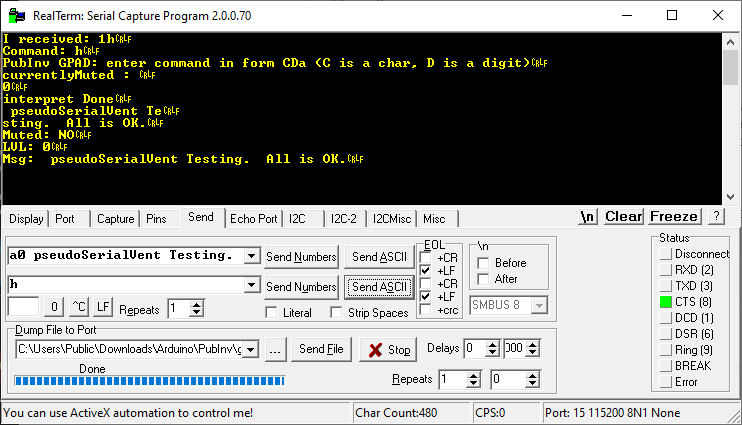
The device will return a message out the serial port with help instructions.
Screen shot of the help message.
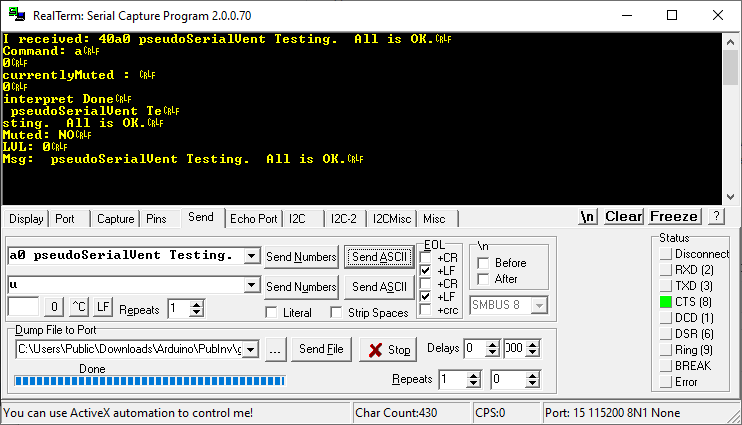
After the GPAD receives a command, it returns text string with a response indicating status.
Example of response to the command "a0 pseudoSerialVent Testing. All is OK."
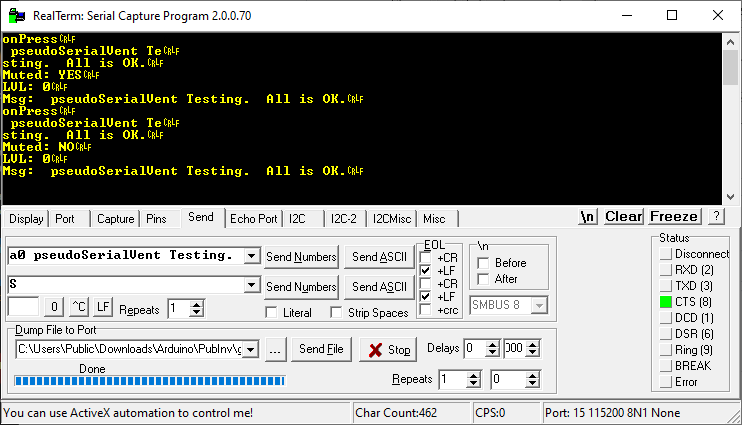
The GPAD has a mute button. Pressing the button will toggle the buzzer on and off.
Text is returned out the serial port indicating the MUTE status as OFF or ON.
The files in the directory are organized to create as much modularity as possible to make future enhancement easy. At present these are:
alarm_api.cpp alarm_api.h gpad_serial.cpp gpad_serial.h gpad_utility.cpp gpad_utility.h GPAD_HAL.cpp GPAD_HAL.h
The "alarm_api" module is main application programmers interface; it is a very high-level abstract alarm module. The "gpad_serial" module handles serial communication of the alarm commands. The "gpad_utility" contains mostly debugging routines needed by all other modules. The "GPAD_HAL" is a low-level api concerning the specific API. It is means to change more rapidly as the hardware evolves than the "alarm_api". At the time of this writing I will shortly add an "spi" module