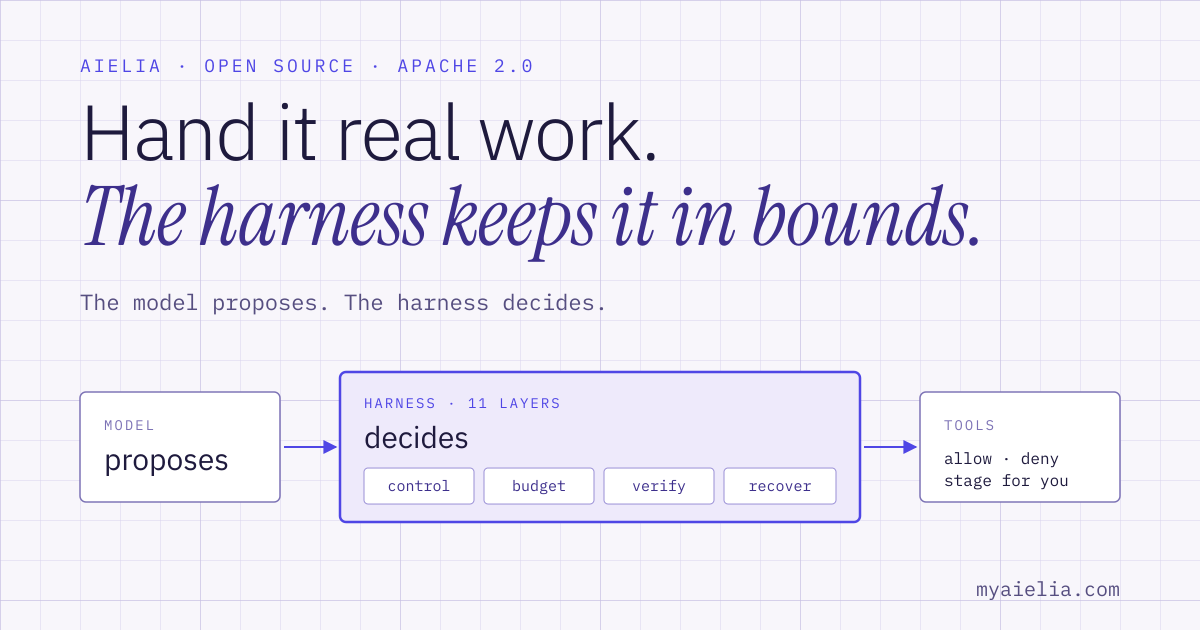



Aielia is an open-source AI agent built with Build A Harness. Hand it a piece of real, multi-step work — research across a list of items, going through the files in a folder, drafting and sending the update — and it works the job through, using tools. What keeps it in bounds is not a prompt: it is code that runs around the model on every turn, deciding what it may do next, what it may believe, whether an answer holds up, and what a job may cost. Anything that can't be undone — writing a file, running a command, sending an email — is staged as an exact action and applied only on your approval.
The difference is the harness. A harness is a governance and reliability control plane wrapped around an autonomous agent: the agent has the intelligence, the harness has the authority. The agent proposes what to do; the harness decides what is actually allowed to happen next; evidence decides whether the result is accepted. Aielia routes every turn through an 11-layer implementation of that control plane — governing what it believes, what it is allowed to do, how it catches its own mistakes, and what it learns.
In your browser → myaielia.com/try
Bring your own model key (Anthropic / OpenAI / OpenRouter). It is stored only in
your browser's localStorage and never proxied server-side. Or watch the
approval gate fire before you add one. There is no Aielia account.
In your terminal:
npx @buildaharness/aieliaFirst run walks you through picking a model — reuse an existing claude CLI
login (no API key needed), or paste an Anthropic / OpenAI / OpenRouter key.
Then just talk to it.
As a library:
import { LLMClient } from '@buildaharness/runtime'
import { PersonalAssistant } from '@buildaharness/aielia'

const aielia = new PersonalAssistant({
  llmClient: new LLMClient({ proxyUrl, authToken }),
})

await aielia.turn('What time zone is Tokyo in?')
// { status: 'ok', reply: '…', riskLevel: 'LOW', stepsUsed: 1 }

await aielia.turn('Send an email to my boss saying I quit.')
// { status: 'needs_approval', reason: '…', riskLevel: 'HIGH' }  — no LLM call made

await aielia.turn('Send an email to my boss saying I quit.', { approved: true })
// approved — proceeds and runs the harness normally
One core, three front ends — terminal CLI, browser (@buildaharness/chat-ui),
and native desktop (@buildaharness/desktop) — all running the identical
harness underneath.
Status: early-stage public alpha (
@buildaharness/aielia0.3.x). Not an audited security product. File and shell access are opt-in and off by default.
Most open agents ship either a permission model or an output-quality gate. Aielia ships both, plus the layers that connect them — six things held in place by code rather than by a prompt: what it may do, what it may believe, whether the answer holds up, what a job may cost, what happens when it goes wrong, and what can't be undone.
- Live per-tool-call ControlState gate — every read-only tool call is
checked against a per-turn
ControlStatebefore it runs (deterministic ALLOW / DENY / REQUIRE_APPROVAL, not advisory), so a developing failure pattern can trip a real deny mid-turn. - Staged effects —
write_file,run_shell_command, andsend_emailnever execute inline. They stage the exact proposed action for approval; once you approve, that staged action runs verbatim — no second model call can improvise a different one. - Bounded jobs — for an explicit list of items, each gets its own bounded
sub-search (budget calibrated on the first items), three dead ends in a row
stop that item, a large batch asks for confirmation before it runs, and a hard
per-turn ceiling caps total tool calls. Every item ends
found,not_found, ortruncated_while_productive, and the reply never silently omits one. - Fail-safe risk classification — a classifier error or unparseable
response returns
UNKNOWN → requires approval, never a silent default to low-risk. - Reviewer Pass — a 3-lens review (consistency, adversarial, abstraction fit) and output-contract validation run before a reply goes out.
- Typed fact provenance — only facts you actually state promote to durable memory by default; model-inferred facts stay session-scoped until confirmed.
- AnswerClaim — replies distinguish "verified against evidence" from "found this but couldn't independently confirm it," surfaced in the chat's "Why?" panel.
- Crash-safe mid-turn resume — a turn that dies mid-flight resumes from its last checkpoint instead of silently starting over; a checkpoint that keeps crashing on replay is discarded automatically after two attempts.
- Untrusted-content boundary — web results and shell output are wrapped as data the model is instructed never to follow as commands, with a warning prefix when the text looks instruction-shaped.
- Private-network guard —
fetch_urlresolves the target host and refuses loopback / RFC1918-private / link-local / cloud-metadata addresses, re-checked on every redirect hop.
Aielia is the @buildaharness/aielia package. Where a heavy
autonomous agent decomposes an objective into a multi-task plan, Aielia
treats every chat message as one objective, one task. That keeps the
harness cheap per turn — the harness loop itself makes no LLM calls, it is
synchronous state-machine bookkeeping — while still walking every layer.
Caller State  →  World Model  →  Evidence & Reasoning  →  Control State
     →  Planning (trivial one-task graph)  →  Execution  →  Verification (9 layers)
     →  Recovery  →  Memory (context compression)  →  Learning (ExperienceStore)
     →  Output & Reviewer Pass
One real LLM call per ordinary turn. Zero for a blocked one. Every layer of the harness is touched on the turns that do run.
| Layer | Role |
|---|---|
| Caller State | Constraints and clarifications carried into the turn |
| World Model | Typed beliefs, contradiction detection, generation IDs |
| Evidence & Reasoning | Observations from tools, tool-reliability tracking, value-of-information |
| Hypothesis | Candidate explanations from multiple sources |
| Contradiction | Belief-graph conflict detection over knowledge-tier facts only |
| Control State | 5-tier resolver → NORMAL / CAUTIOUS / BLOCKED; ALLOW / DENY / REQUIRE_APPROVAL per action |
| Planning | Task graph (one task per chat message here) |
| Execution | Tool dispatch behind the VOI gate and the per-call policy check |
| Verification | 9-layer output verification before a result is accepted |
| Recovery | 6 named recovery strategies over a typed failure library |
| Memory | Six memory tiers (episodic, semantic, procedural, preference, commitment, identity) with structurally-enforced provenance |
| Learning | ExperienceStore — strategy weights, learned decompositions, recovery sequences reused across turns |
| Reviewer Pass | 3-lens adversarial review + output-contract validation |
- Conversation history — kept in a
MemoryAdapter(in-memory by default; IndexedDB in the browser, filesystem in the CLI / desktop app) and fed to the model directly. Each message is also individually indexed so/searchcan resolve a hit to the one exchange that matched. - Risk classification — a cheap keyword heuristic flags consequential requests before the harness and before the one real network call ever runs. A separate LLM-backed classifier produces non-binding hints; the actual approval requirement is always recomputed from structural signals.
- Learning across turns — the
ExperienceStorepersists strategy weights and learned decompositions so they survive a reload.
| Front end | Where | Storage |
|---|---|---|
PersonalAssistant class |
Any Node / browser code | In-memory; bring your own adapter |
CLI (npx @buildaharness/aielia) |
Terminal | Files under ~/.buildaharness/personal-assistant/ (directory name kept from before the rename, so existing installs carry over) |
@buildaharness/chat-ui |
Browser | IndexedDB / Dexie |
@buildaharness/desktop |
Native window (Tauri) | Files under the OS app-data dir |
proxy (a self-hosted @buildaharness/proxy), claude-cli (shells out to an
authenticated claude CLI — no API key), or a provider directly:
anthropic, openai, openrouter with your own key. On the claude-cli
backend, tool calls resolve inside the claude subprocess, so the same
deterministic policy gate is enforced through an ephemeral loopback socket the
MCP server blocks on before executing a read-only call.
Full write-up:
packages/aielia/README.md
in the Build A Harness repo.
Aielia is the reference application. Underneath it is a full visual harness builder — draw the same 11 layers on a canvas, compile to LangGraph / CrewAI / Mastra / MS Agent Framework, and trace every decision in Langfuse.
Canvas → flow.json → LangGraph · CrewAI · Mastra · MS Agent Framework → Langfuse
See buildaharness.com and github.com/3IVIS/buildaharness.
| Aielia website | https://myaielia.com |
| Try Aielia in the browser | https://myaielia.com/try |
| How it works | https://myaielia.com/how-it-works |
| Build A Harness (developer site) | https://buildaharness.com |
| Source (monorepo) | https://github.com/3IVIS/buildaharness |
| npm package | @buildaharness/aielia |
| Assistant deep-dive | packages/aielia/README.md |
| Architecture | docs/architecture.md |
| Threat model | docs/threat-model.md |
Apache 2.0 — see LICENSE. Part of Build A Harness.