

English · Español
Modern, fast desktop GUIs in Python, drawn natively by Iced (Rust).
Components inspired by the Zed editor, a visual designer in the spirit of Godot and Unreal,
node-based shaders, animations, games and built-in AI agents. A modern alternative to tkinter, PyQt, Kivy and Flet.


📖 Documentation · ⬇️ Download Pyzed Design · 🧩 Component library · 📰 Changelog
- Native performance. Python describes the interface; layout, text and drawing are done by Iced 0.14 in
Rust (wgpu on the GPU, tiny-skia on the CPU as a fallback).
import pyzedtakes about 35 ms. - Simple. The Elm architecture: state,
updateandview. A button can call a method directly (on_press=self.save), andupdateaccepts coroutines, generators and streams. - More than 90 components ready to use: buttons, forms, virtual tables with hundreds of thousands of rows, file tree, tabs, command palette, code editor, terminal, custom window frame, charts… They all follow the current theme.
- Pyzed Design, a visual designer installed as an app: draw forms and components, write their code with completion and diagnostics, build node-based shaders and run it all with F5.
- Effects and animations: animate any property, transitions between windows, glow, bloom, blur, glass and
WGSL shaders with
pz.shader. - Games: a game loop (
pz.frames), held keys, sprites and particles withpyzed.game. - AI: an agent panel inside Pyzed Design (Claude, OpenAI, Gemini, Copilot, local models…),
pyzed.agentsfor your own apps and an MCP server so any agent can build apps with Pyzed. - Zed themes: One, Ayu and Gruvbox included, any Zed theme, generated themes and the system's light/dark mode.
- Cross-platform: Linux, macOS and Windows (x86-64 and ARM). IBM Plex fonts and about 2000 Lucide icons included.
- Headless screenshots:
app.screenshot("ui.png")renders without a GPU or a display, ideal for tests and docs.
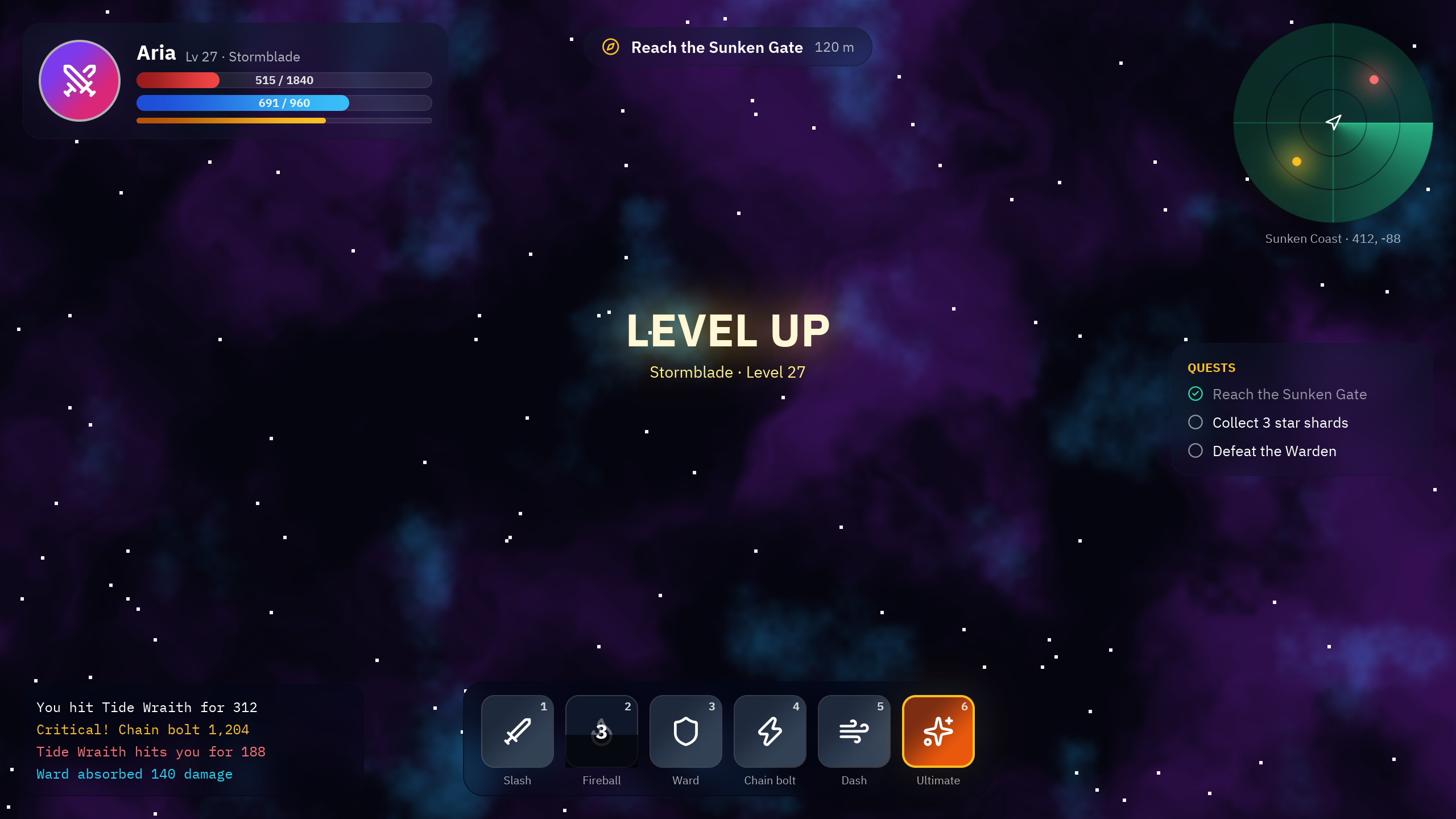 Showcase: game HUD |
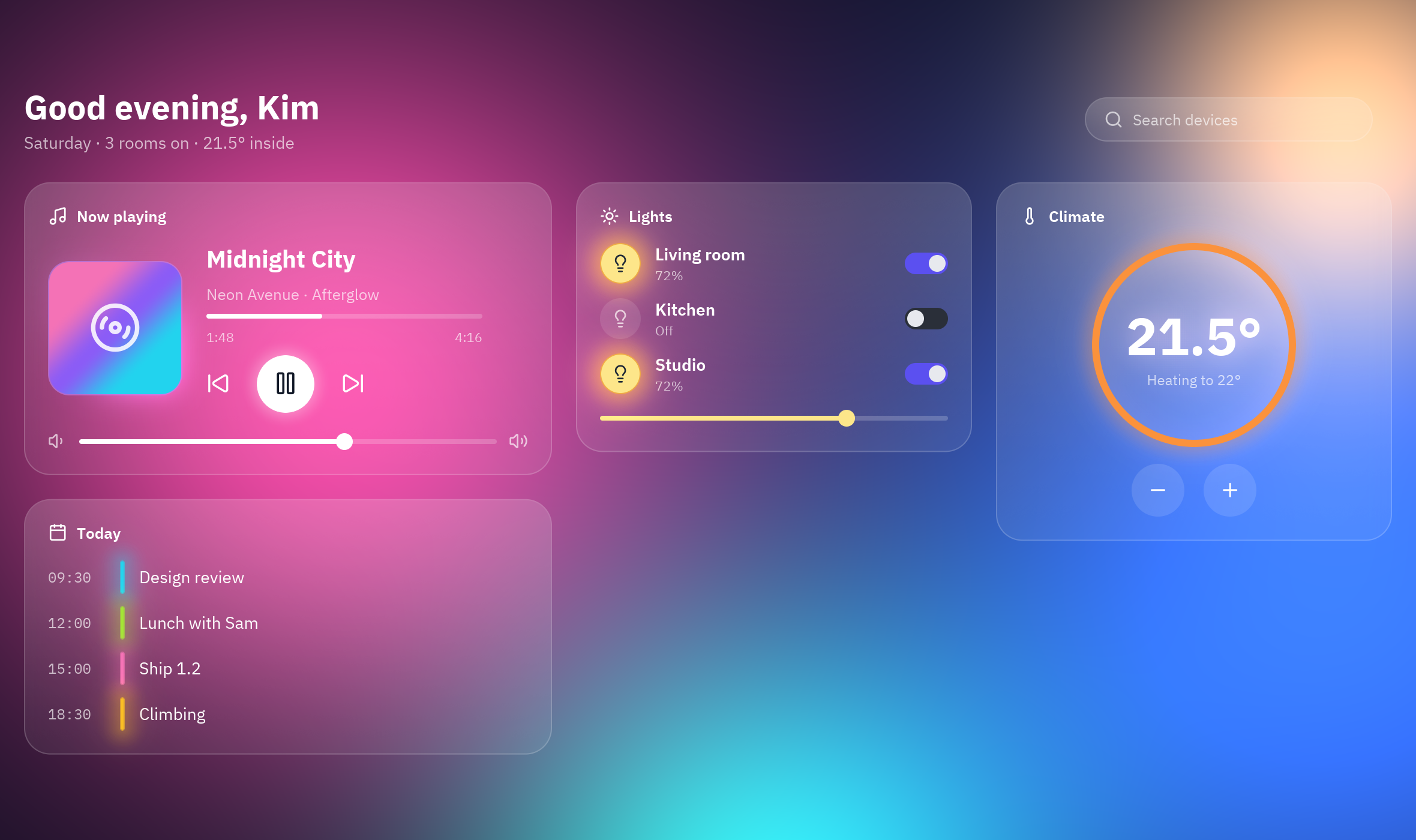 Glass dashboard |
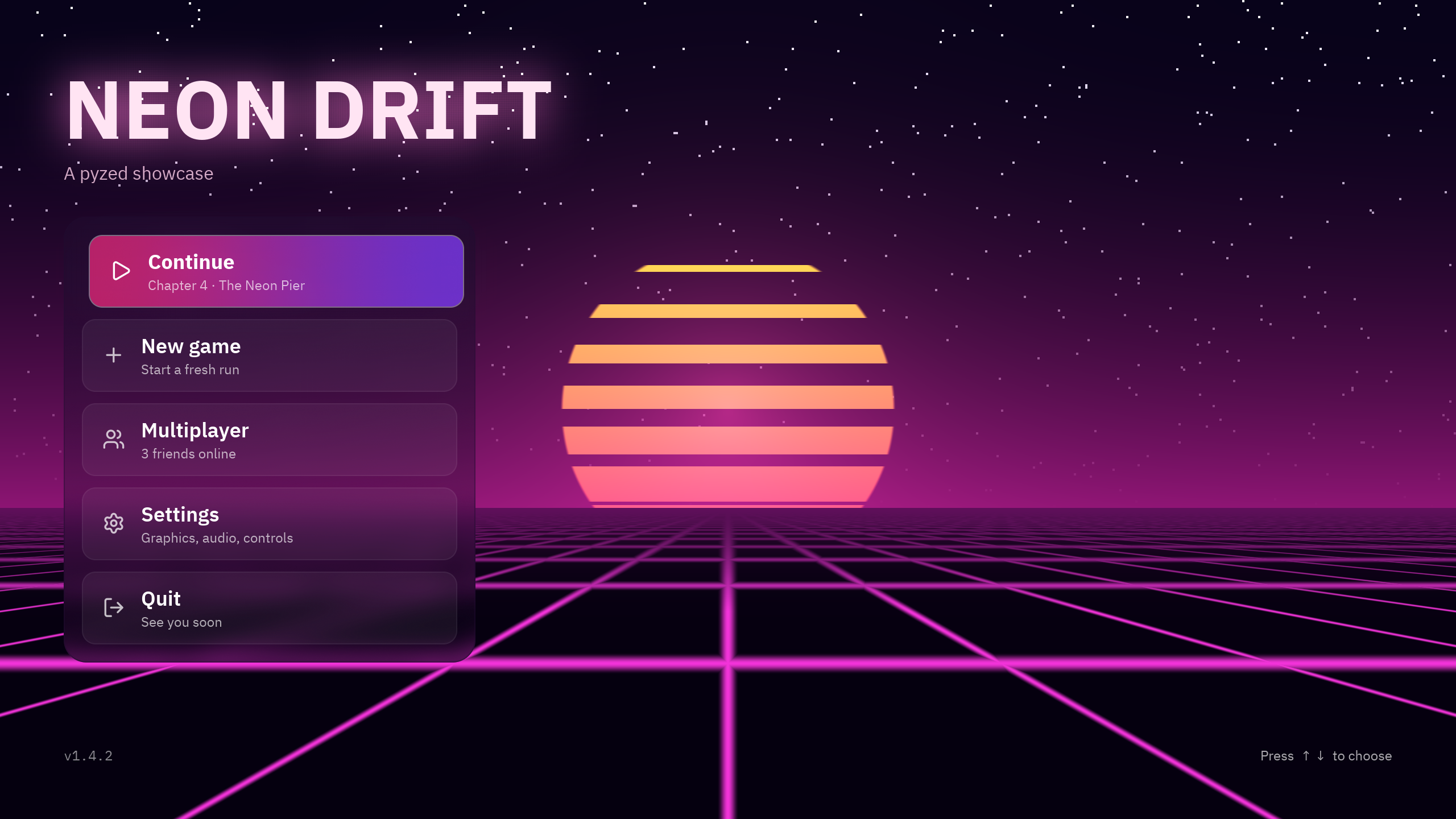 Main menu with shaders |
 Audio: a synth with knobs, scope and spectrum |
You need Python 3.10 or newer. There are wheels for Linux (glibc and musl), macOS and Windows, so Rust is not needed.
uv add pyzed-ui                  # in a uv project
pip install pyzed-ui             # inside an activated virtual environment
python3 -m pip install pyzed-ui  # with the system Python (on Windows: py -m pip install pyzed-ui)
Optional extras: pyzed-ui[mcp] (MCP server) and pyzed-ui[agents] (AI agents in your apps).
The package is pyzed-ui on PyPI and is imported as pyzed. It is not related to the pyzed module of the
Stereolabs ZED camera SDK.
Pyzed Design is installed separately as an app, with installers for Windows and macOS and a script for Linux, and it updates itself: see Download Pyzed Design.
import pyzed as pz
from pyzed import ui


class Counter(pz.App):
    title = "Counter"
    size = (360, 220)

    def __init__(self):
        self.count = 0

    def update(self, message):          # messages can be any Python value
        if message == "increment":
            self.count += 1
        elif message == "decrement":
            self.count -= 1

    def view(self):
        return pz.center(
            pz.column([
                ui.heading(str(self.count)),
                pz.row([
                    ui.button("1", "decrement", icon="minus"),
                    ui.button("1", "increment", icon="plus", variant="solid"),
                    # ...or a callable, which is called directly
                    ui.icon_button("rotate-ccw", lambda: setattr(self, "count", 0), tooltip="Reset"),
                ], spacing=8),
            ], spacing=16, align="center"),
            bg=self.theme.editor,
        )


pz.run(Counter)
Continue with the quick start and the basic, intermediate and advanced tutorials.
pyzed new my-app          # a uv project: UI in ui/, backend in src/, ruff, ty and git
cd my-app
uv run pyzed design       # opens Pyzed Design on the project
uv run pyzed dev main.py  # hot reload: the window updates on save and keeps its state
uv run pyzed build        # an executable for this platform
More in Create a project and Distribute.
A visual designer made with Pyzed, with Zed's interface: drag components onto a grid with anchors, edit their properties and styles, double-click to write the code of each event and press F5 to run it.
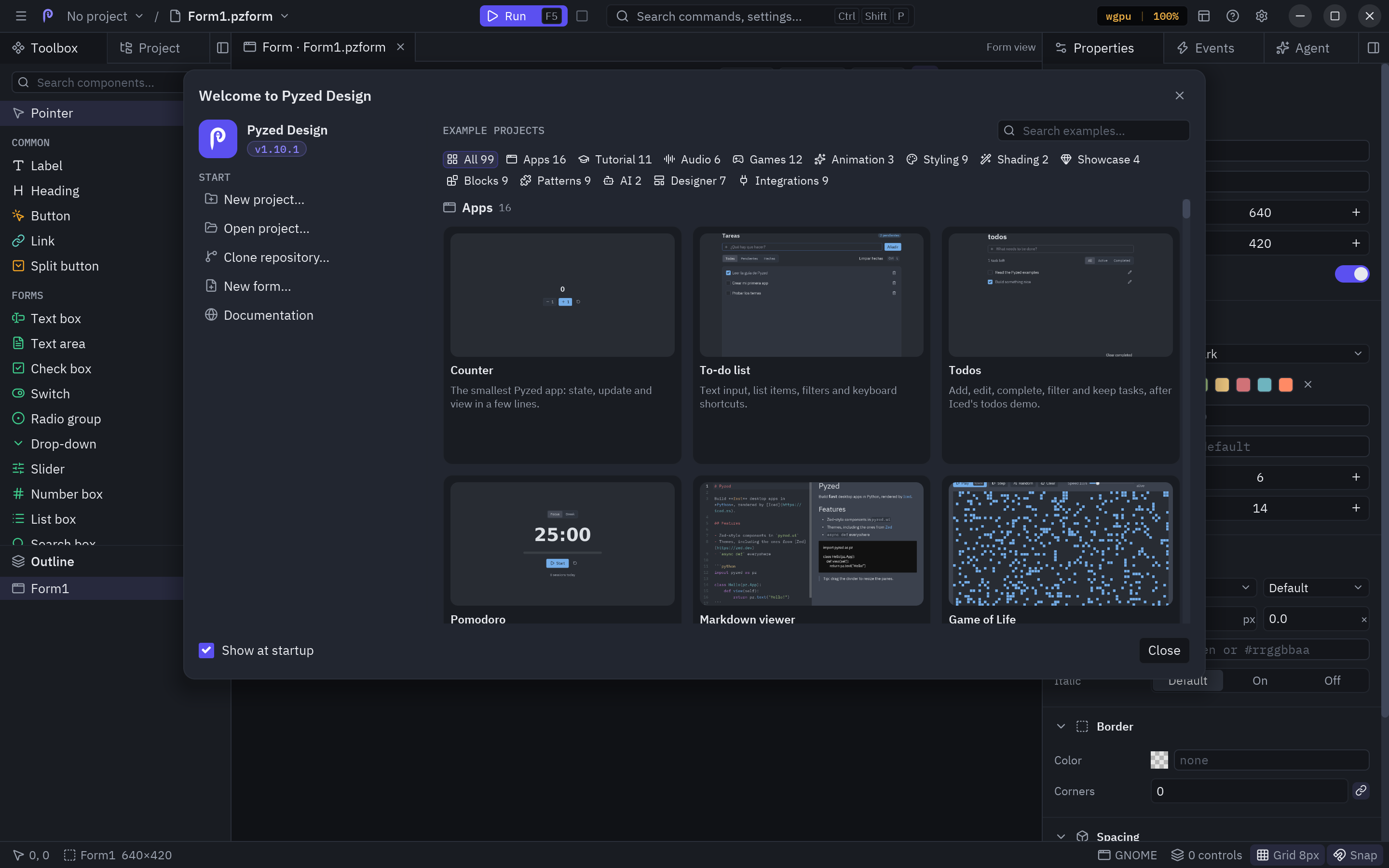 Welcome screen with sample projects |
 Node-based shaders, like in Godot |
 Any tab goes anywhere |
 Non-visual components go to the tray |
- Form, component, shader and code views, with tabs that can be torn off into their own window.
- A Zed-grade code editor: completion with ty, diagnostics with ruff, multiple cursors, find and replace, folding, minimap, configurable shortcuts and IME.
- Project: a file tree with Zed's menu, file search, dependencies with uv and a terminal.
- Custom components with typed properties, inheritance, data binding and validation.
- A built-in AI agent that reads the project, creates forms and complete apps and drives the editor through Pyzed's MCP.
- It updates itself, like Zed, with a what's-new tab.
Full manual in Designer and Shading.
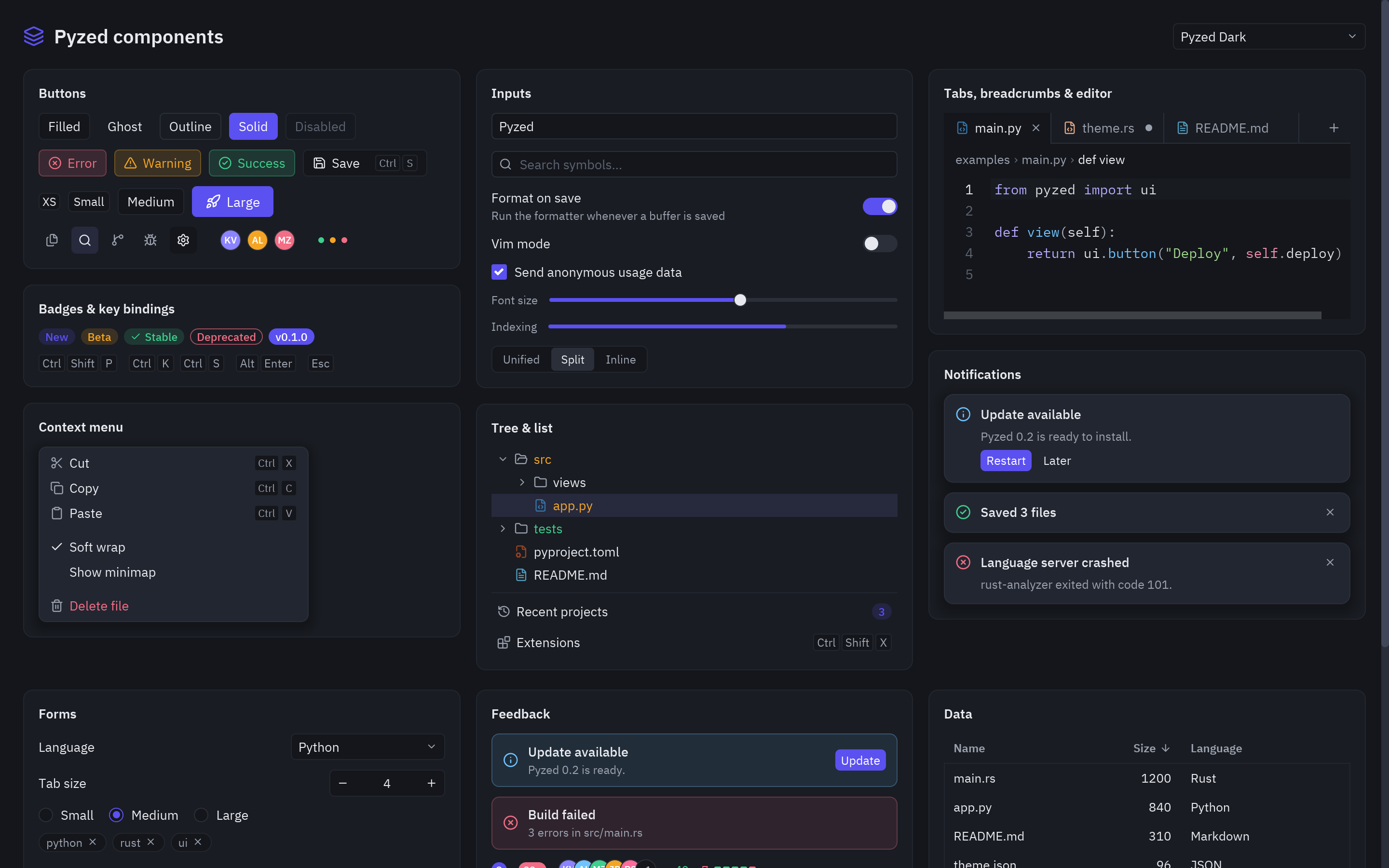
See them in motion (click one to open its page):
 Button |
 Input |
 Select |
 Slider |
 Switch |
 Toast |
 Command palette |
 Menu |
 Tree |
 Calendar |
 Accordion |
 Code editor |
 Hover, press, focus and tooltips |
 Forms with validation |
Every component has its own page with all its variants, examples and API in the library. There are also ready-to-copy blocks: sign-in screens, settings, dashboards…
Any widget has the usual events of a GUI builder (click, double_click, drag, key_down, resize…), and
custom components are classes with annotated props, state and events:
class Rating(pz.Component):
    value: int = 0
    events = {"change": "A star was picked"}

    def render(self):
        return pz.row([pz.text("★" if i <= self.value else "☆").on(click=lambda i=i: self.emit("change", i))
for i in range(1, 6)])Animate any property with presets, keyframes and timelines, move between views with transitions and add glow, particles or your own WGSL shaders. See Animation and Shading.
 Presets, hover and stagger |
 Shaders with pz.shader |
 Transitions |
 Particles |
Every game in examples/games has a step-by-step tutorial in
Games.
 Snake |
 Breakout |
 Neon Invaders |
 Platformer |
 Asteroids |
 2048 |
-
Agent panel in Pyzed Design: sign in to Claude in the browser or with your subscription, or use OpenAI, Gemini, GitHub Copilot, Vertex AI, OpenRouter, Ollama and more. Attach images, connect external MCP servers or ACP agents (Gemini CLI, Codex…).
-
MCP server (
pyzed mcp): Claude, Cursor, VS Code and other agents look up the exact API, generate and check apps and see a screenshot of the result.claude mcp add pyzed -- uvx --from "pyzed-ui[mcp]" pyzed mcp -
pyzed.agentsto add an agent with tools to your own apps.
See AI. For language models, the whole documentation is also available as llms.txt.
Tutorials and runnable demos with FastAPI, SQLAlchemy, SQLModel, Django, httpx and Pydantic:
where each thing runs (UI thread, asyncio loop, worker threads) and how to show validation errors in forms. The
code is in examples/integrations.
Comparisons with tkinter, Qt, Kivy, Flet, Dear PyGui and Toga, with
measured, reproducible benchmarks of startup, memory, updates
and installed size (benchmarks/).
| Folder or file | What it shows |
|---|---|
examples/counter.py, todo.py |
The basics: state, messages, forms and lists. |
examples/gallery.py |
Every component, interactive, with a theme picker. |
examples/zed_editor.py |
A complete code editor over a real folder. |
examples/showcase/ |
Game HUD, main menu, inventory, glass dashboard and shader gallery. |
examples/games/ |
Snake, Breakout and Neon Invaders. |
examples/integrations/ |
FastAPI, SQLAlchemy, SQLModel, Django, httpx, Pydantic and aiosqlite. |
examples/effects.py, animations.py |
Visual effects and animations. |
examples/window_frame.py |
A custom window frame with each platform's menus and buttons. |
examples/ai_chat.py |
A chat with an AI agent. |
examples/designer/ |
A Pyzed Design form (.pzform + .py). |
examples/tutorial/, hot_reload/ |
Step-by-step tutorial and hot reload. |
They all run with python examples/<file>.py (or uv run). More in
Examples.
Python                         Rust (pyzed._core, PyO3)                 Iced 0.14
App.view() ──► Widget tree ──► render.rs: Widget → iced::Element ──► layout + wgpu/tiny-skia
App.update() ◄── messages ◄────── app.rs: Message, Command → Task ◄──── events (mouse, keyboard)
Widgets are immutable Rust objects, so building the view from Python is cheap. The internal state of each editor lives in Rust and the GIL is released while the event loop runs. More in Architecture.
git clone https://github.com/albakore/pyzed && cd pyzed
uv sync                     # builds the Rust core (1.88 or newer) and installs pyzed in editable mode
uv run pytest tests
uv run python examples/gallery.py
See CONTRIBUTING.md. Pyzed follows semantic versioning since 1.0; the policy and known limitations are in Stability.
MIT. The bundled fonts are IBM Plex (SIL Open Font License) and Lucide (ISC); their licenses are in
assets/fonts. The One, Ayu and Gruvbox themes come from the Zed repository (MIT); see
python/pyzed/zed_themes/LICENSE.