

- build:
- cran:
- doi:
- github:


emis_speed() estimates hourly emissions per street with
speed-dependent emission factors. The EMEP/EEA driving-cycle curves used
by ef_ldv_scaled() / ef_hdv_scaled() are compiled to a small stack
machine and evaluated with an OpenMP C kernel (src/e_speed.c). Ages
sharing the same equation are grouped, so each curve is evaluated once
per street-hour. The result matches emis() to machine precision and is
6-17 times faster on a laptop, which makes country-scale hourly
inventories (hundreds of thousands of links) feasible. See the
brazil_bu_speed project and the step-by-step article Understanding
speed-dependent inventories with
emis_speed.
Light-duty hot emission factors (ef_ldv_speed(), ef_ldv_scaled(),
emis_speed(), ef_eea()) come from the EMEP/EEA air pollutant
emission inventory guidebook 2023 - update 2026 (Appendix 4, July 2026).
Fuel consumption is derived from the energy consumption factors, and CO2
from fuel with the carbon balance, so CO2/FC is constant. Other sources
are CETESB (Brazil), the Chinese guidelines, MOVES and EMFAC.
emis_hbefa(), ef_hbefa(), ef_hbefa_cycle() and hbefa_classes()
are an R port of the HBEFA-based emission models (HBEFA v4.2, v3.1 and
v2.1) of Eclipse SUMO, with 962 vehicle
classes. They give instantaneous emissions from speed and acceleration,
constant-speed factors, and averages over driving cycles, as an
alternative to COPERT/EMEP-EEA for European projects. These files are
EPL-2.0 OR GPL-2.0-or-later, see inst/COPYRIGHTS, and the article
HBEFA emission
models.
moves_factors() loads local MOVES data and ef_moves() evaluates
running-exhaust factors in R on Linux, macOS and Windows. Evaluation
needs no MariaDB, SQL, Java or MOVES installation.
Select the vehicle with source_type_id, the fuel with fuel_type_id,
and its manufacturing year with model_year. Both MOVES numeric IDs and
exact names are accepted. For example:
vein::ef_moves(
  pollutant = "NOx",
  source_type_id = "Passenger Car",
  fuel_type_id = "Gasoline",
  model_year = 2020,
  speed = c(20, 40, 60),  # km/h
  temperature = 20        # degrees C
)
#> Units: [g/km]
#> [1] 0.011671836 0.010784581 0.009399917
The bundled reference data cover all 13 MOVES on-road vehicle types and 38 vehicle/fuel combinations with running-exhaust output (gasoline, diesel, E-85, CNG and electricity), for CO and NOx, model years 2000–2025, inventory year 2025, and an urban unrestricted road. They include 16 speed bins and temperatures of 10, 20 and 30 degrees C at 50% relative humidity, using a documented U.S. reference scenario. Vehicle age is inventory year minus model year: a model-year 2020 car is five years old in this dataset.
Use moves_vehicles() to list the available source-type and fuel IDs by
name. For example, a diesel combination long-haul truck:
vein::moves_vehicles()
#>    sourceTypeID               sourceTypeName fuelTypeID
#> 1            11                   Motorcycle          1
#> 2            21                Passenger Car          1
#> 3            21                Passenger Car          2
#> 4            21                Passenger Car          5
#> 5            21                Passenger Car          9
#> 6            31              Passenger Truck          1
#> 7            31              Passenger Truck          2
#> 8            31              Passenger Truck          5
#> 9            31              Passenger Truck          9
#> 10           32       Light Commercial Truck          1
#> 11           32       Light Commercial Truck          2
#> 12           32       Light Commercial Truck          5
#> 13           32       Light Commercial Truck          9
#> 14           41                  Other Buses          1
#> 15           41                  Other Buses          2
#> 16           41                  Other Buses          3
#> 17           42                  Transit Bus          1
#> 18           42                  Transit Bus          2
#> 19           42                  Transit Bus          3
#> 20           43                   School Bus          1
#> 21           43                   School Bus          2
#> 22           43                   School Bus          3
#> 23           51                 Refuse Truck          1
#> 24           51                 Refuse Truck          2
#> 25           51                 Refuse Truck          3
#> 26           52 Single Unit Short-haul Truck          1
#> 27           52 Single Unit Short-haul Truck          2
#> 28           52 Single Unit Short-haul Truck          3
#> 29           53  Single Unit Long-haul Truck          1
#> 30           53  Single Unit Long-haul Truck          2
#> 31           53  Single Unit Long-haul Truck          3
#> 32           54                   Motor Home          1
#> 33           54                   Motor Home          2
#> 34           61 Combination Short-haul Truck          1
#> 35           61 Combination Short-haul Truck          2
#> 36           61 Combination Short-haul Truck          3
#> 37           62  Combination Long-haul Truck          2
#> 38           62  Combination Long-haul Truck          3
#>                    fuelTypeDesc
#> 1                      Gasoline
#> 2                      Gasoline
#> 3                   Diesel Fuel
#> 4                Ethanol (E-85)
#> 5                   Electricity
#> 6                      Gasoline
#> 7                   Diesel Fuel
#> 8                Ethanol (E-85)
#> 9                   Electricity
#> 10                     Gasoline
#> 11                  Diesel Fuel
#> 12               Ethanol (E-85)
#> 13                  Electricity
#> 14                     Gasoline
#> 15                  Diesel Fuel
#> 16 Compressed Natural Gas (CNG)
#> 17                     Gasoline
#> 18                  Diesel Fuel
#> 19 Compressed Natural Gas (CNG)
#> 20                     Gasoline
#> 21                  Diesel Fuel
#> 22 Compressed Natural Gas (CNG)
#> 23                     Gasoline
#> 24                  Diesel Fuel
#> 25 Compressed Natural Gas (CNG)
#> 26                     Gasoline
#> 27                  Diesel Fuel
#> 28 Compressed Natural Gas (CNG)
#> 29                     Gasoline
#> 30                  Diesel Fuel
#> 31 Compressed Natural Gas (CNG)
#> 32                     Gasoline
#> 33                  Diesel Fuel
#> 34                     Gasoline
#> 35                  Diesel Fuel
#> 36 Compressed Natural Gas (CNG)
#> 37                  Diesel Fuel
#> 38 Compressed Natural Gas (CNG)
vein::ef_moves(
  pollutant = "NOx",
  source_type_id = "Combination Long-haul Truck",
  fuel_type_id = "Diesel Fuel",
  model_year = 2020, speed = c(20, 40, 60), temperature = 20
)
#> Units: [g/km]
#> [1] 6.788542 3.318675 2.208248
Start exhaust (ef_moves_start()) and evaporative factors
(ef_moves_evap()) are separate event-based data in g/start and
g/vehicle per hour. They cannot be used as g/km factors in emis();
multiply them by the number of starts or vehicles. Use
moves_start_factors() and moves_evap_factors() to load them. Brake
and tire wear and evaporative emissions while driving are distance
factors: select them in ef_moves() with process = "brake", "tire",
"permeation", "venting" or "leaks".
Other scenarios, pollutants or model years require additional factor
data, which movesr generates: a
standalone R port of the MOVES rate engine (no Java, MariaDB or MOVES)
whose movesr_export_vein() writes the tables read by moves_factors(),
moves_start_factors() and moves_evap_factors() for any county, year,
month, weather and fuel. Omit speed to obtain a function for EmissionFactorsList() and
emis(), or use method = "linear" for bounded interpolation between
speed-bin factors. See MOVES emission factors in
R for the
arguments, available conditions, examples and data provenance.
- See issues GitHub
- Second edition of my book
vein imports functions from spatial packages listed below. In order to install these packages, firstly the user must install the requirements mentioned here.
VEIN can be installed via CRAN or github
install.packages('vein', repos = c('https://atmoschem.r-universe.dev', 'https://cloud.r-project.org'))remotes::install_github("atmoschem/vein")Use the function get_project and read the documentation, there you can see more projects as well.
library(vein)awesome_city <- tempdir()
awesome_city
#> [1] "/tmp/RtmpYYM6af"
get_project(directory = awesome_city,
case = "brazil_bu_chem")
#> Your directory is in /tmp/RtmpYYM6afsystem(paste0("tree ", awesome_city))You have to open the file main.Rproj with Rstudio and then open and
run main.R
To run main.R you will need these extra packages:
- ggplot2
- readxl
- eixport (If you plan to generate WRF Chem emissions file)
If you do not have them already, you can install:
install.packages(c("ggplot2", "readxl", "eixport"))Check the projects here
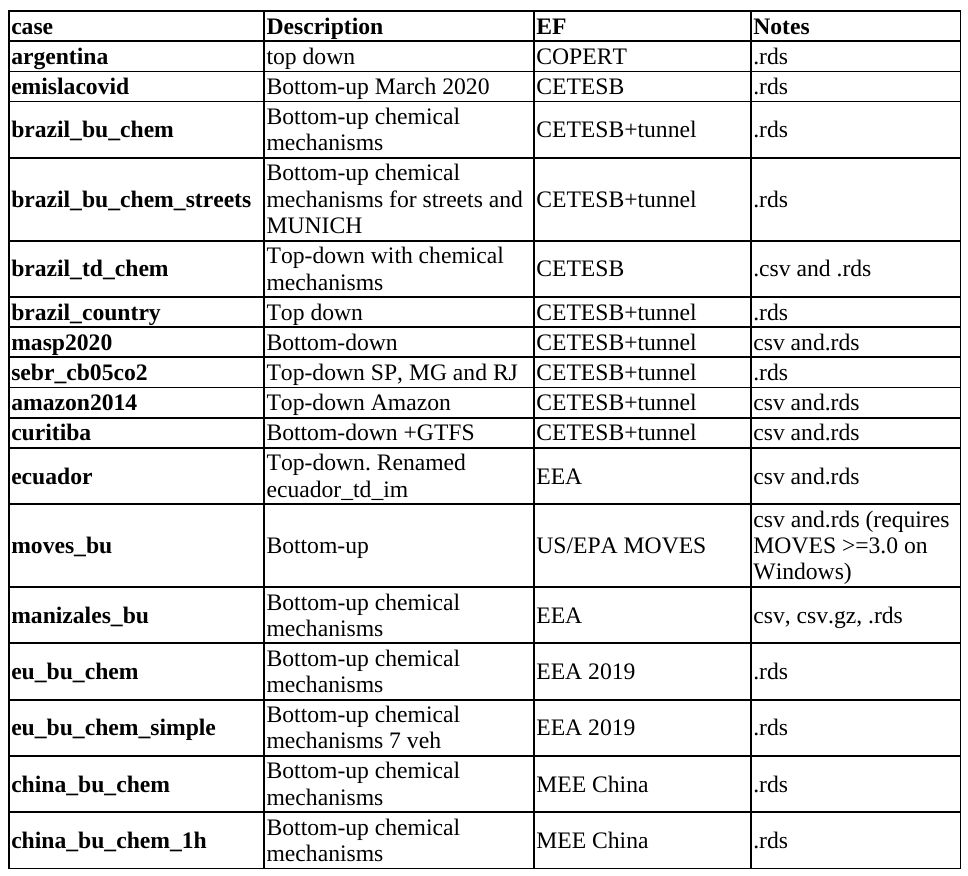
Thanks and enjoy VEIN!
If you use VEIN, please, cite it (BIBTEX, ENDNOTE):
Ibarra-Espinosa, S., Ynoue, R., O’Sullivan, S., Pebesma, E., Andrade, M. D. F., and Osses, M.: VEIN v0.2.2: an R package for bottom-up vehicular emissions inventories, Geosci. Model Dev., 11, 2209-2229, https://doi.org/10.5194/gmd-11-2209-2018, 2018.
@article{gmd-11-2209-2018,
author = {Ibarra-Espinosa, S. and Ynoue, R. and O'Sullivan, S. and Pebesma, E. and Andrade, M. D. F. and Osses, M.},
title = {VEIN v0.2.2: an R package for bottom--up vehicular emissions inventories},
journal = {Geoscientific Model Development},
volume = {11},
year = {2018},
number = {6},
pages = {2209--2229},
url = {https://gmd.copernicus.org/articles/11/2209/2018/},
doi = {10.5194/gmd-11-2209-2018}
}

50
- Earth-Sciences on Stackoverflow, tag vein-r-package
- Drop me an email sergio.ibarraespinosa@colorado.edu or zergioibarra@hotmail.com (你好中国朋友 - Hello Chinese friends!)
- Check the group on GoogleGroups Group.
If you encounter any issues while using VEIN, please submit your issues to: https://github.com/atmoschem/vein/issues/ If you have any suggestions just let me know to sergio.ibarra@usp.br.
Please, read this guide. Contributions of all sorts are welcome, issues and pull requests are the preferred ways of sharing them. When contributing pull requests, please follow the Google’s R Style Guide.
Sometimes you need to install R and all dependencies and a way for doing that is using anaconda. Well, as my system is in portuguese, after installing R using anaconda it changed the decimal character to ‘,’. In order to change it back to english meaning decimal separator as ‘.’, I added this variable into the .bashrc
nano ~/.bashrc
export Lang=C
More details on StackOverflow
Stargazers